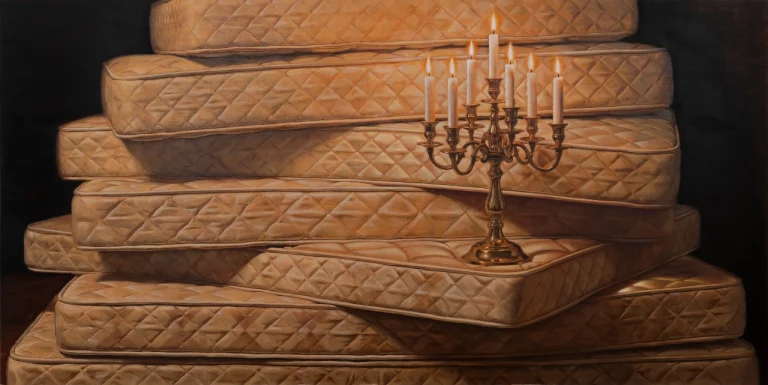
The Amsterdam-based artist turns everyday objects into meditative studies of colour and form.
When a simple idea is executed well, it can be utterly satisfying. And when we mean simple, we mean the objects that you look at all the time – or the tools you might use every day. Hugo Rocci is a master of noticing these things. In his most recent series, he’s painted the humble paint brush – “an homage to the brush as a tool,” he says, an idea that arose after visiting Pigment, a shop in Tokyo that displays its brushes on the wall. “We often overlook the beauty of the objects we use every day, focusing only on their function rather than their form.”
Hugo is drawn to the allure of the things we miss or tend to glaze over. “Tools, machines, construction materials and furniture are usually valued for their practicality, but they also have a raw and understated beauty. They are a big part of our daily lives, yet we rarely stop to look at them.” And so, he will actively go searching for them, keeping his eyes wide open when he’s on his travels.
Perhaps it’s his upbringing that allowed him to view the world this way, and to ultimately turn it into art. He grew up in the south of France, and after his studies, he moved to Amsterdam to study at Gerrit Rietveld Academie and spawned a love of textiles, ceramics, books and painting. As a grad, he started a studio with some friends, and an ‘ah-ha’ moment really lifted off. “I have always been an object collector,” he admits.
“These days I collect brushes, wooden rules, honey bears – don’t ask me why. I’ve been collecting things since I was a child.” His idea was to start bringing these objects into his work and to set up a bookshop, printshop and publishing house with Terry Bleu – a place where he can work with artists and bring his love for material matter into the world.
So, as an avid collector and a keen observer, what exactly catches his eye, and how does he find it? More than anything, it’s the “simplicity and humble presence”. And what he’ll do is frame and isolate these familiar items to gain a closer and more lens-in perspective, “one that notices the subtle charm, textures, colours and elegance in things we often pass by.” For him, it’s all about slowing down and noticing things that are right in front of us.
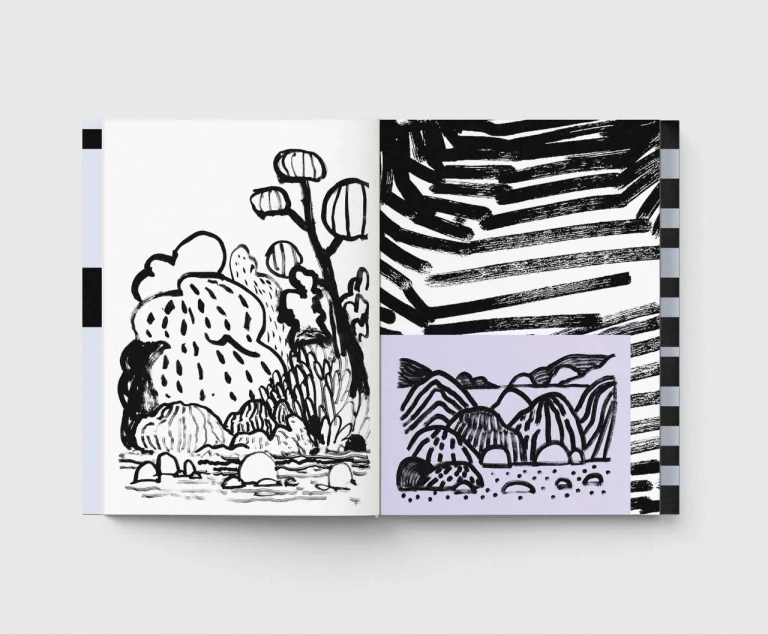
When he’s found an object, he begins sketching before bringing the idea to a canvas – he likes the rough cotton-linen ones he buys at the nearby market. Then he uses pencils for tracing, with the lines usually visible in the outcome, and then wets the canvas with water and pigment from De Kat, which he says is a windmill in Zaandam that makes its own pigments, and mixes with casein. “This allows me to control whether the paint is thick or very thin, and I use this as a first layer to place the colours.” He also works with oil paint to create “sharper, thicker and shinier” outcomes when he wants them.
Hugo just returned from a trip to South Korea and, right now, he’s nestling away at a new collection of paintings focusing on kitchen appliances – such as cooling fans, scales and clocks. He plans to turn it into a series, and perhaps they might make you think about the items around you in a different light.
Not only are his works well-crafted and satisfying to look at, but they also make you realise how much beauty is around you. They also tend to spark up a lot of conversation with avid collectors like himself. “I’m always happy to share my love for collections and to have conversations with the audience,” he finishes.
“I’m often surprised by how many people tell me about their own personal collections of brushes or other objects. I really like that. People care a lot about well-crafted objects and the stories behind them, and I think this work creates space for those stories to be shared.”