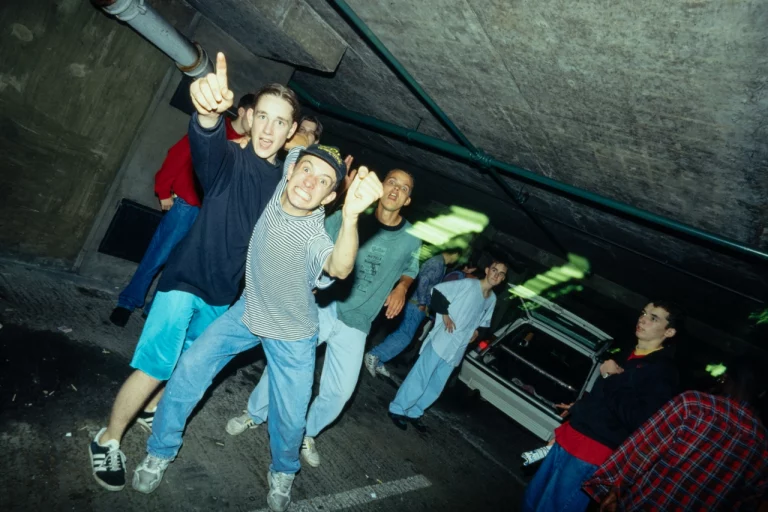
Hockney-inspired self-portrait © Gayle Kabaker
The New Yorker cover artist on why a cover still feels like a miracle, the morning David Hockney died, and learning to paint bedding like water.
Gayle Kabaker has illustrated some of the most recognisable covers The New Yorker has ever run, but she will be the first to tell you the gigs always astonish her. “It never stops feeling like a miracle,” she tells Creative Boom. “Partly because I send so many ideas and finished paintings that I get no response back, or that get rejected, so when I do get a cover, that’s why it seems miraculous. But the joy of seeing my art on the cover of The New Yorker just never changes, either. It’s always such a thrill.”
It’s this mix of persistence and wonder that runs through everything she makes. It was there, too, at the very beginning. Her first New Yorker cover, June Brides, marked a turning point in her career as well as how she paints. She had started working in a looser, more painterly style, and at the time it met resistance. “My agents at the time said they didn’t think it was a very marketable style and they didn’t want to put it on the website,” she remembers. When the possibility of a cover came along – in exactly that new style – she pushed back. “I kind of insisted that they put this new style of work up. Maybe it is marketable, and it turned out I was right.”
She had a hunch that the disappointment might be hiding something better. The painting that became June Brides came out of a family show she staged around 16 years ago, a body of work full of women in beautiful gowns that, to her dismay, sold only a few. “I was actually quite disappointed,” she says. “But within six months, I had turned one of those paintings into June Brides, which became my first New Yorker cover. So I’d say I had a better outcome than I would have if I had sold all the paintings from my show. I always try not to be attached to the outcome I’m hoping for, because maybe the universe has a better plan.”
All The New Yorker covers © Gayle Kabaker
Swim, The New Yorker © Gayle Kabaker
Brides Send, The New Yorker © Gayle Kabaker
The morning, everything stopped
Her openness to redirection was tested earlier this month, when Gayle woke to the news that David Hockney had died at 88. “I saw it first thing in the morning, and I immediately texted my artist friend Noah Woods, who met me in Paris last June, so that both of us could go to the Hockney exhibition for two days.” She put aside her plans and sat down to write – a newsletter about how deeply his work had shaped hers, and the whole story behind it.
The story began at the Met, in front of one of his pool paintings. “I heard a whisper saying you must paint people in pools,” she says. “I followed this guidance, and it took me down a path of starting to paint people in pools, and made me start to paint water and oceans in a completely different way.” Her approach to water is now far more interpretive, almost abstract. She photographs her subjects, then converts the images to high-contrast black-and-white, so she reads everything in terms of shapes and tones. “The more I draw on location, the more I start to see things clearly, then I interpret them however I want to make it my own view.”
In the days after Hockney’s death, she gave herself completely to his work. “I spent the weekend painting, looking at his work, and just being inspired by it – giving myself permission to use a pattern that he might’ve used for a sky, or to be really inspired by a pattern that he used for grass or wheat in a field.” The painting that emerged is one she is especially proud of. If she could have asked him anything, she says, it would have been about portraiture: “This is something I know I’m good at, but it takes a lot of reworking for me to get a likeness most of the time, and I would love to get better at catching a likeness that’s enough of the person’s spirit to make everyone happy.”
A pneumonia, a terrible mattress and a new series
Gayle works best in quiet. She lives in the countryside and guards the peace fiercely. “I really try to have a very spiritual connection with the universe, and being quiet is part of being able to listen to the muse,” she says. “If life is too busy and chaotic, I won’t hear it.”
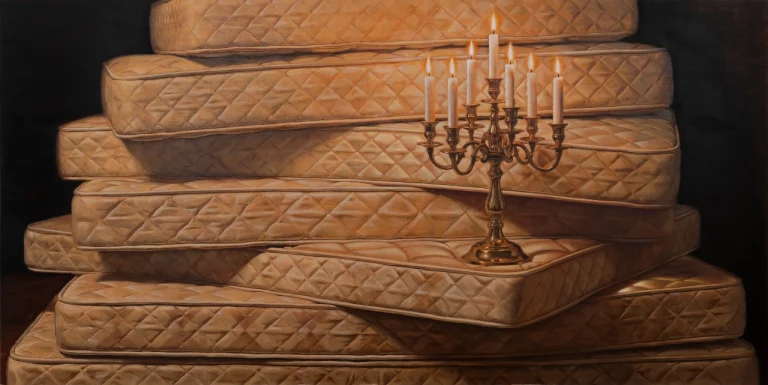
Listening recently led somewhere she never expected. While teaching two back-to-back workshops in Greece, planning to paint people in water, she came down with pneumonia on day three. The weather turned, the water was off-limits, and the island Airbnb she had booked to paint in turned out to be miserable. So she left early for a hotel in Athens – and woke at 6am with an idea loud enough to get her out of bed. “I could paint bedding in a similar way that I paint water,” she says. She set up her tripod and phone, used herself as the figure reference, took screenshots to draw from, and began studying the folds. “I realised I was right.”
Aluna Floating © Gayle Kabaker
Bed © Gayle Kabaker
There is a great detail here: after a decade hosting a glamping-style Airbnb on her own property – ranked number one in searches in Massachusetts more than once – Gayle considers herself something of a bedding expert. “The bed was terrible, the sheets were polyester,” she laughs about the island rental. Back in her studio, the discomfort became a body of work. The resulting bed series shows a woman sleeping alone, and Gayle is clear about what it means. “One person saw her as being lonely, and I see her as simply revelling in rest. There’s absolutely nothing lonely about these paintings to me. They’re more a celebration of sleep and rest and self-care.”
Teaching, granddaughters and the long game
For all the solitude, community keeps her engaged: a network of artist friends who inspire her, and a teaching partnership with Jennifer Orkin Lewis, known as August Wren. Together, they have run 13 weeklong workshops around the world over the past four years, with a 2027 retreat in France now on sale. Teaching, she says, has changed her. “It’s been an incredible opportunity for me to become a better person – a better human being. I’ve learned how vulnerable and fragile people can be when you’re teaching them in person, and how to respond in a way that is helpful and not hurtful. That took some learning, some mistakes, and some tears.”
France © Gayle Kabaker
Family Sleeping © Gayle Kabaker
Mona 10th June © Gayle Kabaker
She has no patience for cutting corners. “Kind of like Malcolm Gladwell’s 10,000 hours, there are just no shortcuts. It just takes putting in the time to get better.” These days, she is hooked on the weekly portrait sessions run by Chloe Briggs at DrawingIsFree.org – two to four minutes a face, no agenda. The same no-pressure spirit drives the sketchbook series she has kept of her granddaughters for five and a half years, now on its fifth book. She set three rules when Mona was born: she had to be having fun, it didn’t need to look like her, and there was no professional or monetary goal attached. “It was purely for fun,” she says – though it resonates with people anyway. Now Mona, who loves to draw, sits and turns the pages with her over a steaming cup of milk and a coffee.
There is plenty still on the list. A collaboration with a fashion designer, turning safari paintings into fabric for a collection (“and stay in the giraffe hotel”). Animated titles for a film or TV show. It is the same instinct that once took her to Australia with a 10-person crew for a collaboration between The New Yorker, Condé Nast Traveller, and Tourism Australia – a project she calls life-changing, right down to learning what H&MU means.
When you consider all she’s shared, you can see there’s a quiet conviction that the work matters most when it gives something back. A single Washington Post illustration about the second women’s march, paid almost nothing, led to a years-long collaboration with Vital Voices and a book of 100 portraits, Vital Voices: 100 Women Using Their Power to Empower. “In these crazy times in our country and in the world, I hope that my work can bring a bit of light and joy into someone’s life,” she says. “Teaching feels like a good way to give back.”
Christina in the Field © Gayle Kabaker