The Enough and Fuzzy Feelings director and filmmaker returns to short filmmaking with a tender, funny and increasingly unhinged portrait of people who just want to be loved.
Most of us spend a fair amount of energy hiding the needy, pathetic parts of ourselves. (I know I do.) Anna Mantzaris wanted to put them on screen instead. Her new stop-motion short, Please, is a comedy about the very human longing to love and be loved – told through a run of loosely connected, tender and absurd scenes, and anchored by a starring voice performance from Oscar-nominated Swedish actor Stellan Skarsgård as a character named Winston.
The film won Best Short Film at Animafest Zagreb earlier this month and will be screened at the Annecy International Animation Film Festival this week. It marks Anna’s return to short filmmaking after her enormously successful Good Intentions and Enough, and her Emmy-winning film for Apple, Fuzzy Feelings. Anna, who also animated on Wes Anderson’s Isle of Dogs, wrote and directed Please, with additional voices from Molly Nilsson, Jonatan Unge and Ika Nord, and music by Phil Brookes.
The idea has been bubbling in her head for ages. “It started during the Covid pandemic and the lockdowns in London, when everyone was so isolated for a long time and so much became online,” she tells Creative Boom. “We became more obsessed with our self-image because we saw ourselves on screens in Zoom calls all day. We spent a lot of time looking at ourselves while feeling disconnected from other people.” It was this acute self-awareness running alongside a deep hunger for connection that became the film’s beating heart. “I wanted the characters to try to break out of this bubble, to reach out, to show their longing, but in a not-so-perfect way.”
Running through Please is Anna’s pushback against self-help culture and its promise that we can optimise our way out of difficult feelings. “I love the flaws we have as humans – I think it’s what makes us interesting and relatable,” she says. “There’s this self-improvement idea that we can somehow decide what and when to feel something, that it’s something we could control. I don’t really believe that. To feel needy or pathetic is part of being human. I wanted to let those feelings exist rather than fix them.
“I’m interested in the difference between what we show the world and what we actually feel. Presenting the ‘ugly’ feelings through the puppets makes us feel seen. They get to do it for us, so we feel we’re not alone.”
Instead of a single narrative, Please is built from overlapping vignettes that reappear and gradually accumulate into something much bigger. “I love observations – little moments that tell a lot,” Anna explains. “Working in a vignette-like way suits me. I also like the idea that many people are struggling with the same thing.” It’s an approach she developed on Enough and wanted to push further. “I’ve kept the vignette format, but now we revisit characters and give them a couple of beats on their journey. There’s a lot of freedom to play with rhythm, escalation and the juxtaposition of scenes. I love the idea that the combination of little scenes can together tell a bigger story.”
If you’re familiar with Anna’s work, you’ll know it’s always lived in the awkwardness of something being sad and funny all at once. Finding that line, she says, is largely instinct. “It’s just a gut feeling. Most of the time, you can hold things a lot longer than you think – more is more. It’s better to push it too far and then bring it back a little bit.”
The casting of Skarsgård came about by chance. “My producer, Johan Edström, is the landlord of Stellan’s office in Stockholm and knows him,” Anna says. “Johan sent him the script, and Stellan replied, ‘When can we do it?'”
Behind the camera, Please was a genuinely European undertaking. Co-production was spread across Sweden, France, the Czech Republic, Norway and Finland. It was produced by APPARAT Filmproduktion AB and co-produced by Passion Paris, with Arte, Film i Väst, SVT, Mikrofilm AS and Kuli Film, in association with YLE and Böhle Studios, and distributed by Miyu.
Directing a stop-motion film across that many countries took serious coordination. “We had to do it this way because it was a European co-production, and because there were so many sets and setups,” she says. “It actually worked well – all the studios worked really hard. But it was complex and needed extra planning, like a style bible for set design and a cinematography supervisor to ensure all the lighting maintained a similar tone and followed the chronological order we needed. In a single studio, it would have taken a lot longer, or needed a much bigger team.”
The puppet-making process that Creative Boom first explored with the painstaking craft behind Enough remains broadly the same, refined over years of commercial work. The team made more than 40 puppets in Anna’s Stockholm studio, all built on wire armatures. “Wire armature was a must for time and budget, and I actually prefer it,” she says. “I like how you can customise the shapes so much, and have more rounded arms and legs. But I’ve advanced the puppet-making a lot since Enough – the details in the face, the eyes, the shoes.” A costume maker in Prague sewed the outfits from textiles that Anna sourced before the puppets were shipped to their shooting locations. “A lot of DHL expenses, to say the least.”
Returning to personal work after commercial projects has been its own reward. “Commercial projects have allowed me to evolve a lot, and I’ve met so many talented people I’ve learned from,” she says. “I like that it’s fast, a big crew, decent budget, lots of problem-solving – it has good energy. But personal projects are something I’d missed. At its core, it means more to me. It takes a long time, and the budgets are a fraction, so it’s heavier work – but also more rewarding.”
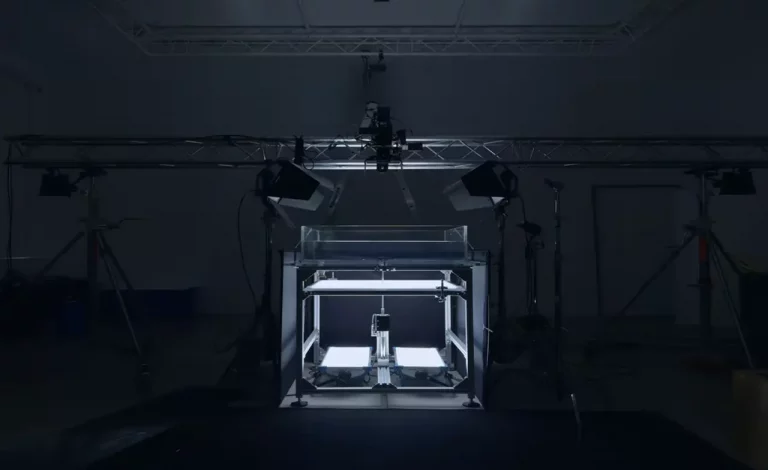
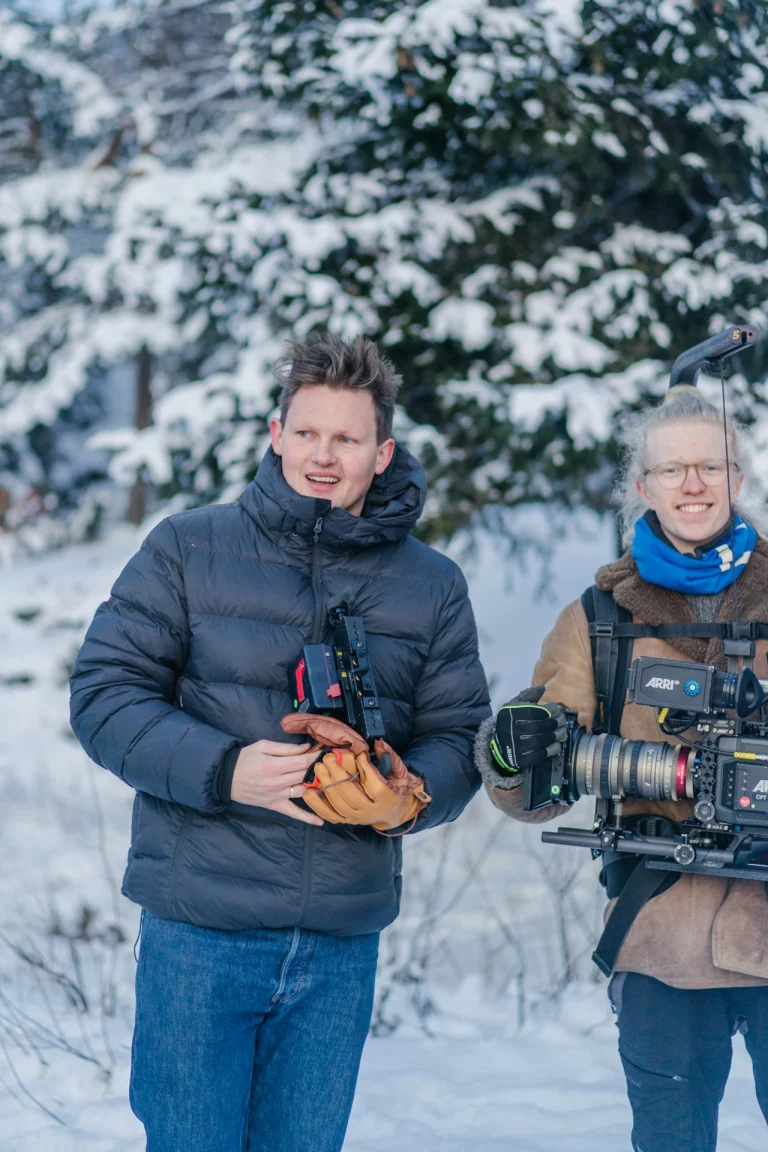
BTS from the filming of Please. Photography by Donna Wade
In her head throughout were the filmmaker Roy Andersson (“always in my head”), the films of Ulrich Seidl (Animal Love and In the Basement), and Liv Strömqvist’s comic The Reddest Rose Unfolds, about romantic love through the ages. As for how far she’s willing to push an audience as the film tips into chaos, Anna isn’t thinking about comfort at all. “I think about what fits the film and what the characters need. I’ve thought of it as three acts, and in the third, a lot of the characters give in, let go, or lose it. I like it when they get a bit unhinged and do something drastic.”
So what does she hope people feel as they walk out? “I hope they think it’s funny and heartwarming but also a bit sad at the same time,” she says. “And that they feel seen. We’re all just humans, and we’re all a bit messy and needy sometimes.”
Next comes Annecy, then a proper break in Spain. “I need it after a year and a half making this film.” After that, an art grant in Sweden and some early-stage ideas to develop through the autumn, alongside the festival run. Brilliant stuff as always. We can’t wait to see more.