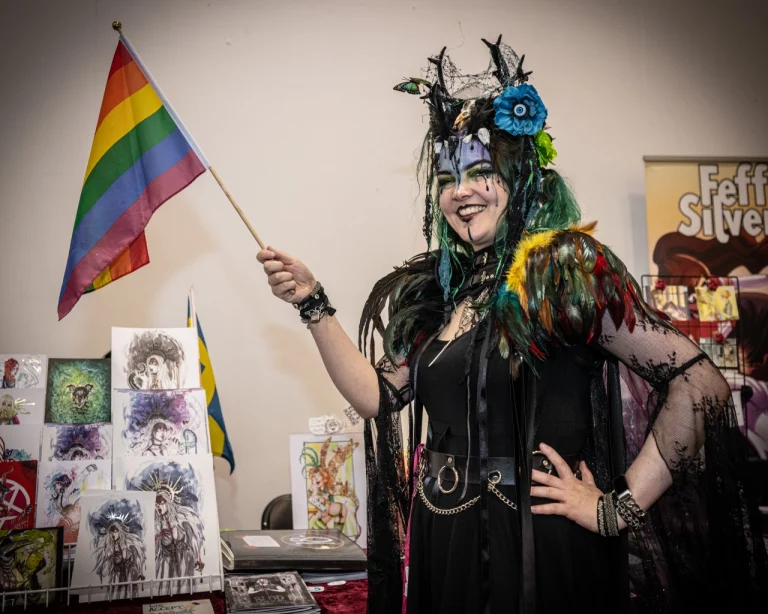
Sarah Jane Coleman AKA Inky Mole has illustrated nearly 100 fairies, monsters and other fae creatures for Dr Elizabeth Dearnley’s upcoming book The Fairy Spotter’s Guide.
“These things may or may not actually exist. I think they all do, but that’s for another discussion,” says Sarah Jane Coleman, as we talk about the challenges of depicting mythical and folkloric creatures from all around the world.
“Pictures are scarce,” she continues. “You can find myriad impressions of, say, Nessie, but Nunavut’s Qallupilluit, Hawaii’s Mo’o or Mexico’s El Coco, who is terrifying, are less easy to find.”
Everything Sarah mentions is to appear in The Fairy Spotter’s Guide, written by Dr Elizabeth Dearnley, which comes out in September from Hachette. Whereas many of the books about fairies we’ve come across in the past focus on European folklore, this edition crosses continents and cultures to catalogue some 80 weird and wonderful creatures, including over 100 of Sarah’s illustrations.
The Impadulu
Ghūl is one of Sarah’s favourites.
Say ‘No’ to El Coco.
The Nottingham-based artist was a natural choice for the project. Her portfolio is full of ghosts and beasties, spiderwebs and shadows, with a vintage, gothic vibe facilitated by her use of natural media such as calligraphic pens, pencils, watercolour and a bit of collage. She deliberately leaned into a handmade, non-digital aesthetic for the book, and the outcome feels completely authentic to the subject matter.
“I wanted to feel like a late-Victorian textbook artist, working away at these terrible fae with a scratchy fountain pen under gaslight,” says Sarah. “Elizabeth and I are showcasing creatures that are ancient, organic, textured; who would, if you were to get close enough, wreak havoc with your understanding of what’s real and what’s not.”
“In the spirit of the folklore itself, I wanted these pictures to be entirely physical – they exist outside a screen – and there’s a seat-of-the-pantsness to committing an illustration to paper that you can’t feel with all-pixels, as they are so easily deleted.”
Work in progress
Part animal was part of the brief.
Working from the manuscript, with just a little direction from the art directors, Sarah’s approach was spontaneous and instinctive. There were back-and-forth discussions about how the illustrations would populate the book – whether full page, DPS or spot – but she dived straight in and started on the first creature as soon as the brief was settled.
With so many of the folkloric creatures new to Sarah and beyond even the scope of Google, she relied on the author’s text – often based on oral tradition and translation – and came up with her own interpretation of what they’d look like. Plenty of trust came her way from the art directors. It turns out her favourites were generally the hardest to draw.
Baobhan Sith – the Sith predate Star Wars. Who knew?
El Chupacabra
Abaia
“I’m really not good at drawing animals, and so when I saw how many of these were animal-based or human-animal hybrid, I had the tiniest little panic attack. As an illustrator, it’s often assumed you can ‘draw anything’, but I am living proof that’s not the case! Those ended up being favourites because I was forced to really put the effort in, like being back at college – among them are El Chupacabra, the Werehyena and the soaring Impudulu,” says Sarah.
Others she would add include El Coco, which does horrible things but of which there are very few visual impressions, and Ghūl, a changeling-type creature. “So, he’s saying, ‘Yeah, you KNEW it wasn’t Graham, didn’t you? And where’s Graham now?’ Answer: He’s likely to have been eaten,” she says.
Both illustrator and author are credited as the creators of The Fairy Spotter’s Guide, and both are very pleased with the outcome. If there were 80 more creatures to draw, Sarah would do it all again. But right now, she’s working on her first solo book – written and illustrated by Sarah Jane Coleman and coming out in January.
Werehyena
Tokoloshe