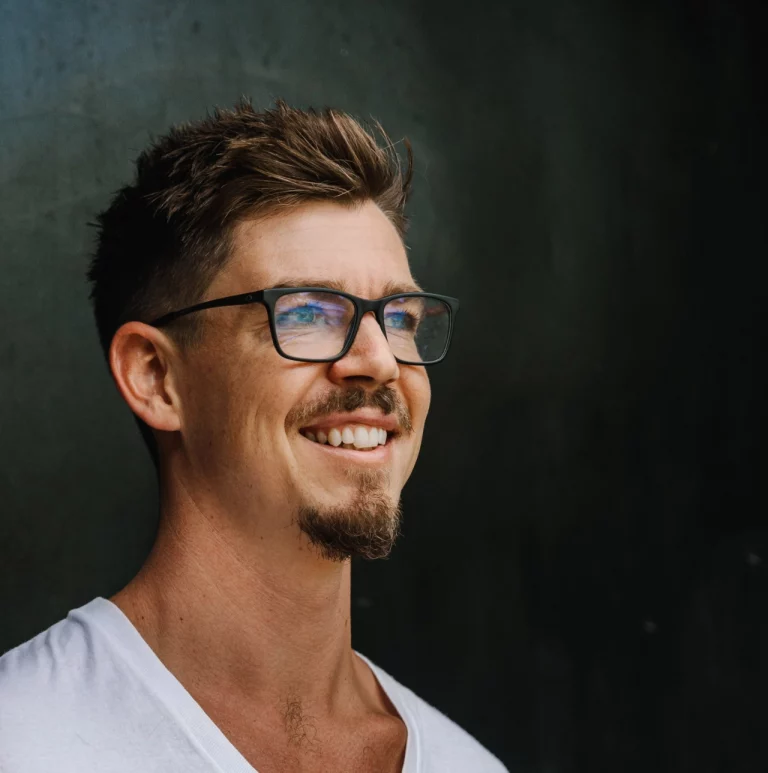
The founder of Kwoo Studio discusses how he’s made a name for himself after a career pivot and a move across the Atlantic.
Right now, many of us are contemplating either a career change or a geographical move (or both) as the twin engines of AI and economic contraction threaten the jobs we currently hold dear. And that’s a scary prospect, but it’s worth remembering that, actually, pivoting mid-career isn’t itself a bad thing. People have been doing this for generations, for all sorts of reasons, and sometimes it could be the best thing that ever happened to you.
Kent Wood is currently going through that transition. “I used to think that by 30, you were supposed to have everything figured out in life,” he says. “Instead, I moved countries, changed careers, learned motion design and started building a studio.”
Having moved from America to England to support his partner, he’s set up in business as Kwoo Studio, and he’s already attracted attention on social media, where he’s been writing about his experiences and sharing his work, such as his concept case study for a fictional furniture brand, Belo. And it turns out he’s not alone.
“Since sharing my story online, I’ve had a flood of comments, DMs, and emails from people telling me they’ve recently quit their jobs, moved countries, or changed careers,” he tells us. “We’re in a time of rapid innovation, and that always brings big change. People of all ages are self-reflecting and rethinking what they truly want their lives to look like, particularly outside of work. My generation, Millennials and Gen Z, are on the front lines of it all, and a lot of us are taking huge risks as a result.”
A global odyssey
That same thinking is what brought him to Manchester. “I’m here supporting my partner, who decided to return to academia after a brief stint in the corporate world and take up a new role at the university,” he explains. “We eloped to Ireland back in 2022 and had always been open to living in the EU or UK if the right opportunity ever came along.”
His path to design, meanwhile, has not been straightforward. Having grown up in the Caribbean, he moved to Florida for university, where he studied kinesiology, the study of human movement. He’s since lived in Florida, Texas and back in the Caribbean, where he founded a company distributing wholesale goods to hotels and restaurants.
“In many ways, the reason I eventually left feels familiar to what we’re all experiencing in the design industry today,” he says. “That business model was constantly shifting, and keeping pace meant working unsustainable hours while navigating shrinking profit margins, rising operational costs, and major supply chain disruptions. As the ground kept moving underfoot, I found myself questioning if I had a future there.
“The cumulative effect of constantly adapting to challenges and facing a model that no longer felt sustainable made me reconsider doing that work long term,” he continues. “Around the same time, my partner was offered a role in the UK, so the move here presented an opportunity for a fresh start.”
Passion for design
Running his own business was where he first developed a passion for marketing and design. “I had complete creative control,” he says. “Pricing, inventory, the business name, the logo, colours, font pairings, imagery—I taught myself to use a DSLR—copywriting, radio ads, storefront graphics, even the website build.”
Having previously studied kinesiology, it felt like a full-circle moment when Kent eventually became a motion designer. He’s since taken everything he learned from business and brand design into his own studio. “Focusing on motion systems for brands, I’ve morphed it all into what I call Motion Brand Design,” he says. “In my view, it’s the future of branding, where modern brand identity extends beyond static guidelines into motion identity systems.”
On a personal note, he’s found northern England a breath of fresh air. “I’d like to thank all the Northern creatives who have been nothing but welcoming since I started coming out to events,” he enthuses. “As a newbie to town, that support has meant the world to me. I hope events like Process, The Northern Design Festival, and Motion North keep growing, and I look forward to becoming more involved as time goes on.
And he’s determined to share his journey along the way. “I’m all in on putting yourself out there,” he stresses. “You have to be smart about it, of course, making sure what you share aligns with what your brand stands for. But whether creatives should have a digital presence isn’t even a debate in my opinion.”
Sharing his story
In his case, it’s already paid off. “I secured a meeting with a studio up north to walk through my case study and connect with their team of experienced designers,” he explains. “Beyond that, sharing my story has helped me meet so many nice people and get on the radar in a place where I didn’t really know anyone.
“I’ve been able to get to know, and even grab a drink with, loads of people in the industry doing amazing things, people I’d never have met if I weren’t online. When you’ve shared your journey, there’s a warmth to those introductions; people feel like they already know you, which makes meeting other freelancers and building your network so much easier.”
He’d urge anyone in the same boat to do the same. “If you’re like me and don’t have a huge network of client referrals or agencies keeping you booked, it’s the best way to make a name for yourself, market your business and promote your work,” he reasons. “It’s essentially free to post, for now at least, so we should take full advantage. At the end of the day, it should simply be viewed as your new digital business card.”