Growing up in Weston-super-Mare, the artist found an escape in cartoons and animation. Now, she’s turning that lifelong obsession into painstakingly painted rotoscoped works that are full of life and cracking dance moves.
There is something wonderfully stubborn about painting an animation frame by frame. While the moving image is usually associated with speed and technology, Ellie Campbell is interested in exactly what happens when you slow the whole thing down and use a paintbrush to create the visuals. Her hand-painted rotoscope animations take real footage and pull it apart, exaggerating bodies and gestures into familiar scenes – throwing shapes on the dancefloor, watching a duck swim across the pond or sipping a cold frosty pint to name just a few.
Ellie was born in Weston-Super-Mare, a small and quaint seaside town that she says had a large influence on her creative journey. Coming from a small town, it wasn’t a surprise to get weird stares or be picked on about my love for art, media and overall expression,” she explains. “Nonetheless, it holds a special place in my heart; being able to visit Dismaland in my hometown was a game changer. Living in Weston and growing up lower class shaped my perspective and pursuit of art.”
Her practice has remained difficult to pin down, which suits an artist who seems happiest when she is pushing things around and testing the limits of different mediums. This is why she describes herself as a mixed-media artist specialising in hand-painted rotoscope animation, using traditional processes inside a digital world to create work that is “textured, trippy and unapologetically human”. At Loughborough University, where she recently completed her Fine Art degree, that approach developed into immersive moving-image installations which combined painted animation with TouchDesigner.
When speaking of her influence, she cites cartoons as being a constant throughout. Ellie grew up watching them and remains fascinated by their exaggerated forms and ability to communicate through movement. There’s also something about the sheer labour of animation that appeals to her. “It’s truly phenomenal,” she says. “I also find inspiration in a desire to learn outside of my own experiences; within my projects, I make it an objective to have taken something away from it.”
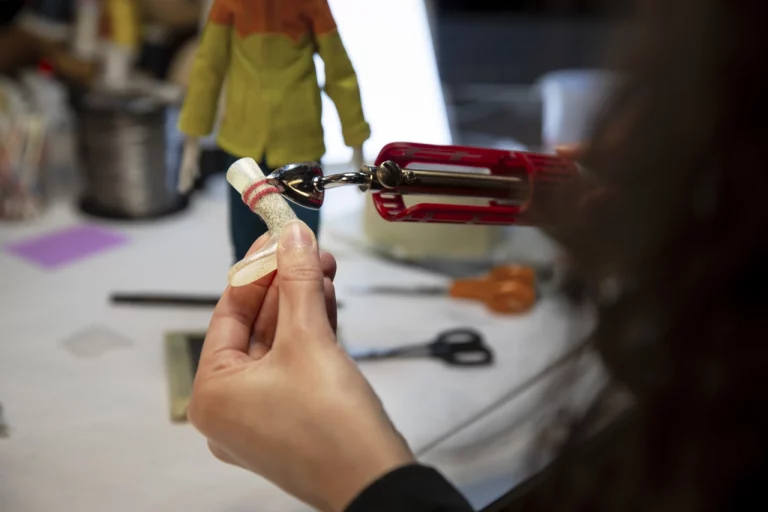
And when it’s time to get her hands all painty, Ellie first starts with research, digging around online for footage, free stock video and archival material, or heading out to record something herself. Each frame is then turned into a photograph and printed onto contact sheets. Working predominantly at 25 frames per second, although increasingly at 20 when time is tight, she paints through the sequence by hand, moving through colours and frames until an entire page has been built up.
It’s an intensely repetitive process, but Ellie leaves plenty of room for mischief. She might allow the original footage to show through the paint or introduce “obnoxious googly-like eyes” and “ridiculous in-between frames”. She says, “It really makes a piece feel personal and ups the wackiness.”
Her degree-show project, Dance, took that fascination with movement into the nightclub. Ellie wanted to recreate the feeling of being on a night out when everything becomes slightly loose and blurry. Dance 17 is one of her favourites, capturing what she describes as the “nostalgic, upbeat and wild, which is how clubbing used to be”… and she’s not wrong! Dance 8 is another favourite, which gave her space to push her love of exaggerated movement, with dancers punching the air and having a smooth in the background.
Meanwhile, the wider project explores the dance floor as a palace where choreographed routines and spontaneous moves collide, with 1,195 hand-printed frames teleporting us back to good old days on the dance floor.
Ellie’s work really is a love of labour. “I was told recently that my work made someone feel emotional due to how much time I clearly spent painting frame by frame, while I’ve also been told it looks like an acid trip. While both are completely different reactions, I think they’re what I anticipate with my work. I want people to admire the small details and how strangely imperfect or bizarre it can all appear simultaneously,” she says.
“When I present certain projects that have a body of work or theme, I want to immerse the audience in the same way I try my best to immerse myself in the subject – to make them feel like they’re visually related to what is before them.”