The French illustrator draws on everything from trail running and wooden toys to everyday encounters, piecing together charming, colourful compositions that celebrate the joy of making things.
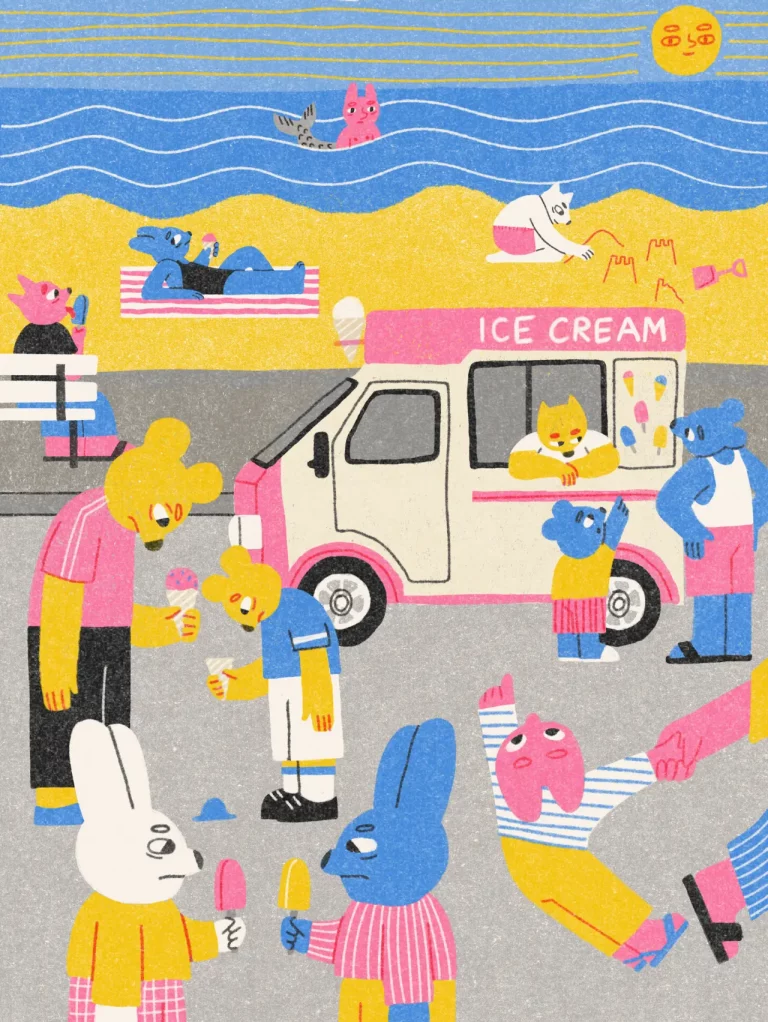
Sheep, wooden toys, polka dots and foam – these are just a few of the things that French illustrator Ines Launay keeps close at hand when she’s making work, alongside a fondness for wandering, textile crafts, costumes and the occasional absurdity. It’s a wonderfully peculiar collection of interests, but one that makes perfect sense when you look through her portfolio, where loose pencil marks, wonky characters, and little snippets of everyday life come together in playful, unexpected ways.
In one illustration, a group of people gather outside a Japanese shopfront, surrounded by bicycles, colourful signs and tiny details that keep you looking for ages and ages. Elsewhere, illustrated pages are filled with handwritten notes, miniature figures, landscapes and the odd speech bubble, resembling a cross between a travel diary, a comic and a collection of memories. There’s a lovely handmade quality to it all, with the warmth of coloured pencils and the inky brushstrokes giving her work a deliciously tactile feel.
For Ines, drawing has been a constant since childhood. Growing up in a small town in central France, she was introduced to art by her grandparents, who both painted, while her grandmother also ran small modelling workshops. She took drawing classes for several years, though she remembers them more as afternoons spent drawing with friends than formal lessons. “Like many children, I loved drawing,” she recalls. “For me, it was a way to exist, and I never really stopped. Today, drawing is part of my daily life, part of who I am, and part of how I see the world.”
After studying illustration in Paris for three years and graduating in 2024, Ines has been figuring out how to fit her creative practice around a full-time job, which currently pays the bills. It’s a balancing act that also involves her love of sport, particularly trail running, hiking and cycling, activities that regularly find their way into her drawings through the places she visits and the thoughts she has along the way.
With limited time to create, she’s developed a process that involves making small separate pencil drawings before assembling them digitally. Rather than starting with a fully formed composition, she lets the individual elements accumulate and works out how they might fit together afterwards. “The final piece is often just the result of a graphic wandering,” she explains. “I find it very hard to imagine one image as a whole, something complete on its own. That’s also why I draw small separate pieces first, and only afterwards I think about what to do with them.”
It’s an approach shaped partly by two artists she particularly admires, Paul Cox and Sammy Stein, whose work opened her eyes to different ways of telling stories through images. “Their work spoke to me right away, and when I feel creatively lost, I like to go back to it,” says Ines. She also recalls Sammy’s observation that comics are, “in part, graphic design”, an idea that resonates with her own interest in composition and the relationship between individual drawings on the page.
Two projects that capture these interests particularly well are Levain, her 2024 graduation project, and Sur les pas d’Ella Maillart, an illustrated travel notebook. The former is a graphic novel about three friends experimenting with different ways of living and inhabiting the world, presented through an intriguing mixture of landscapes, small figures and colourful graphic arrangements. The latter follows a journey through Switzerland in the footsteps of adventurer and travel writer Ella Maillart, undertaken with Louane Carmona and Coline Balfroid, who made an accompanying video documentary.
The pages of Sur les pas d’Ella Maillart are packed with delicate pencil drawings, handwritten observations and little scenes from the journey, with the informal quality of a sketchbook that someone has kindly invited you to flick through. “Graphically and narratively, they have plenty of flaws, but I learned a lot from them, and it’s so rewarding to create a finished object – not just an image shared on a screen,” Ines says. “On one side, there’s the travel-notebook format, where I tell the story of my adventures – whether trips or races. On the other, there’s a more experiential side with Levain, which holds my fads and my questions.”
While her illustrations have an unmistakable sense of curiosity and play, Ines is also candid about questioning the purpose of making art, particularly when the world can feel so overwhelming. “With everything happening in the world, everything quickly feels pointless,” she says.
Yet looking at other people’s work still gives her “that little spark of curiosity, that boost of motivation, that feeling of joy and pleasure that I need every day.” Perhaps that’s what makes her work so appealing. Whether she’s recording a journey, experimenting with an arrangement on pencil sketches or following an idea to see where it goes, there’s something infectious about her willingness to keep making and trying things out.