Amsterdam agency Verve finds a refreshingly different way to brand Helsinki startup Zero.
Here’s a riddle for you. When is a flight delay actually a good thing?
When it gives you a bizarre but brilliant slice of inspiration for an identity project, of course.
This is exactly what went down when Amsterdam creative agency Verve flew to Helsinki to throw around some ideas with the founders of AI startup Zero. Stuck in the city with time to kill, the Verve team wandered into a small museum, the Amos Rex, which is known for its subterranean galleries topped by undulating, dome-like skylights. As part of its Generation 2026 exhibition, there was a piece by ceramic artist [Johan Urrutia], depicting a typewriter that had turned to stone.
“Extinct office technology: that was the story,” says creative director Walewijn den Boer. And this simple idea became the key to the visual identity they created for Zero.
“The old tools are turning to stone, and Zero is bringing the new ones,” says Walewijn. “The more you live an assignment, the richer your associations get, and the more personal the work becomes.”
The new identity dramatises this notion by treating Zero’s arrival as an extinction event. Legacy CRM is presented as a Stone Age world of cracked earth and fossilised tools. Zero is something so advanced it barely reads as technology at all. And the line “Make CRM history” ties everything together.
Story of evolution
CRM, which stands for Customer Relationship Management, is one of the oldest categories in business software and has long been dominated by two huge companies: Salesforce and HubSpot.
“What I love about Zero is that it’s a story of evolution,” says strategy director Eveline Koppejan. “Salesforce and HubSpot were once the challengers kicking against what came before and now, decades later, they’re the incumbents, and a new generation is ready to kick back. The brand gives Zero the conviction to say that out loud.”
Zero isn’t only up against the big names, though. A wave of AI-native rivals is springing up, and most share the same dark-mode, crypto-adjacent startup look. To separate Zero, Verve offered founders several different visual territories, from an anti-brand rebellion to a safer lifestyle-tech route, but the extinction event won out.
“Compared with the other AI-native players, the product gap is slim, because everybody copies each other’s features and that’s easy to do now,” says Walewijn. “When the product becomes a chat interface, there’s no feature or screenshot left to hide behind. Brand is what differentiates.”
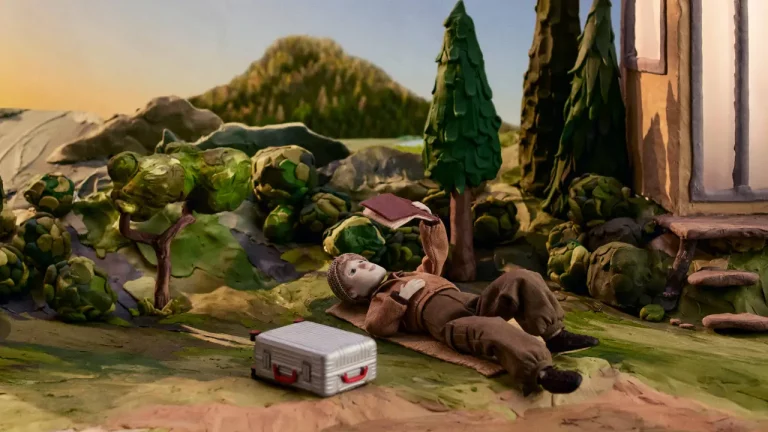
Visually, they’ve really taken the idea and run with it. A hand-illustrated Neolithic landscape by Verve illustrator Kevin Lebon is full of cracked earth, drifting monoliths and fossilised tools. Cave drawings show the age-old frustrations of selling with legacy CRM.
References range from the dawn-of-man opening of the movie 2001: A Space Odyssey (1969) to the ship hovering over the desert in Arrival (2016). Zero’s brand identity sits over the top, sleek and precise, showing how each of those problems gets solved.
Brand character and colour
Verve also created a brand character called Zorb: a gleaming, all-knowing space object with a small dot-matrix face it uses to emote. It makes its moods known through force fields made from hand-drawn cave inscriptions.
Previously, Zero was known for its signature yellow, which came about after the founders originally came up with the startup’s name in a restaurant with yellow tables. Nobody else in the category owns the colour, so Verve decided to keep it on board, pairing it with a deep oxblood and a soft blue, while the typeface is Install by Calame.Bureau.
Craft that scales
Lebon drew the illustrations by hand, then fed them into Figma Weave, an AI tool, to generate large numbers of new landscapes and scenes within the same art direction. That sounds like the sort of thing many agencies are doing with AI these days, but generally like to keep it on the downlow. Walewijn, though, feels he has nothing to hide.
“I’m a little allergic to people defending craft at all costs, as if the old world and the new can’t mix,” he maintains. “You can have a completely crafted system that also scales with AI tools, as long as our input stays in the lead. Off-kilter thinking you can’t replicate, then scaled. That’s the way to go.”
Zero is the first project to come out of Verve’s new duo model, in which a creative director and a strategist lead each client together, from strategy and creative through to account management. Walewijn and Eveline led the work, with Michelle Arrazcaeta also working on strategy.
“Going through an assignment with creative and strategy side by side, even getting stuck in a museum together, creates very human insights that are hard to replicate,” says Walewijn.
The importance of timing
For Zero, the timing matters. It’s currently moving towards a chat-only, “zero-click” interface, the goal its name partly comes from, and Zorb is designed to become the face of the product as that happens.
“It’s a brand that can mature with them,” says Walewijn. “There’s a whole world here for campaigns and events, and as the product becomes a conversation, Zorb can become the face of everything Zero does.”
Before the rebrand, says Niko Salkola, founding designer at Zero, “we felt that the ideas were running in circles: what are we, what do we look like, and how do we differentiate ourselves?
“Verve helped us align that understanding with the founders and the whole team. The story now feels strong and like something we can build on top of. The amount of work Verve put into building the concept was truly inspiring. It is something we never would have been able to do on our own.”