As rigid agency models continue to give way to smaller, more fluid ways of working, In-Col Studio is part of a growing wave of creative businesses proving that lean structures and trust-led collaboration can be just as powerful as scale.
The 2000s and early 2010s were the golden age of the independent agency as we know it. Carefully structured teams, clearly defined departments, glossy studios and steady headcount growth were all seen as markers of success.
Then, around 2020, the world changed as we faced the pandemic, and the industry had to adapt quickly. Overheads became harder to justify, clients grew more demanding, budgets tightened, and suddenly the old models felt more like baggage.
In their place, a different kind of studio has emerged. They’re smaller, more nimble, and built around networks rather than hierarchies. They’re less interested in looking big and more focused on working well. London-based In-Col Studio sits squarely within that shift, operating as a lean creative studio with a global network and a dual focus on AI-led tech brands and major cultural institutions.
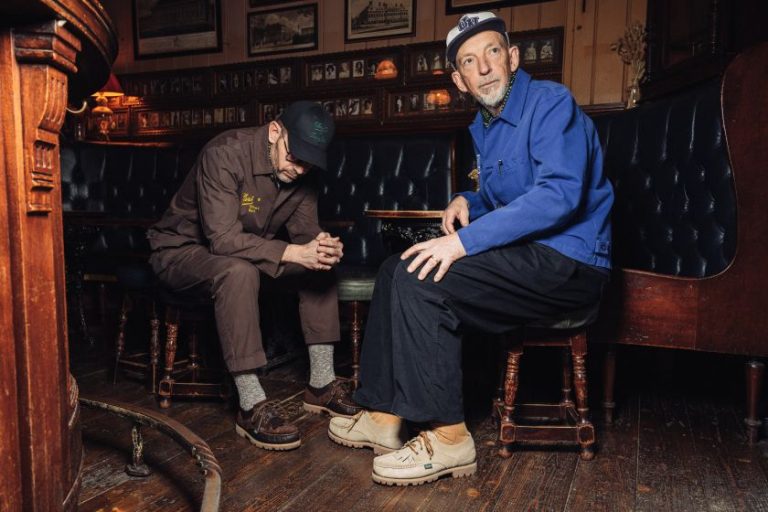
Iain Worgan
Niall Lewis
Founded by Iain Worgan and Niall Lewis, In-Col officially began taking shape during the pandemic years, when remote working stopped being a perk and became a necessity. The pair met while studying at the Royal College of Art, drawn together by a shared interest in typography, systems and cultural work, but arriving there from very different paths.
Iain, originally from Manchester, had already spent a good few years in the industry before enrolling on the RCA’s master’s programme. “I wasn’t particularly happy with where my career was going,” he says. London felt like a reset button, and the RCA, he hoped, would introduce him to people who wanted to work differently.
Niall’s route was less conventional. Raised on the Isle of Wight, he worked in a wind turbine factory before pursuing graphic design more seriously, immersing himself in typography through programmes with Fraser Muggeridge and Erik Brandt. By the time he reached the RCA, he was already freelancing for Nike and record labels, bringing a deep typographic sensibility shaped outside traditional agency culture.
As a result, contrast became one of In-Col’s strengths. “We’ve had very different journeys,” Iain says, “but we’ve come together with different skill sets, which is really useful.” When the pandemic flattened distinctions between office-based and remote work, it also created space for the studio to form without the usual pressure of scale. Clients became collaborators, and shared projects turned into a shared business.
Today, In-Col operates with a deliberately small internal team: Iain, Niall and one designer. Everything else is built through an external network spanning the UK, Europe and the US. “Instead of huge overheads, we keep our internal costs really lean,” Iain explains. “Then if a brand comes to us with a specific need, whether that’s 3D rendering, set design or motion, we build the right team around the project.”
It’s a model that reflects wider changes across the creative industries. Budgets, particularly for founder-led tech and AI startups, rarely stretch to six-figure brand programmes anymore. At the same time, expectations remain high. “People don’t want any less for smaller budgets,” Iain says. “So you have to shift how you work.”
In-Col’s response has been to split its practice across two distinct but connected worlds. On the one hand, fast-moving tech and AI brands often operate on a 24-month growth horizon. On the other, established cultural institutions such as the Royal Academy and the Barbican. Rather than seeing these as opposing forces, the studio treats them as complementary.
“The idea is cross-pollination,” Iain explains. Institutional clients bring process, rigour and long-term thinking. Startups bring energy, speed and a willingness to experiment. “We take institutional process into chaotic startups, and startup energy into institutions,” he says. “That balance keeps things interesting.”
One project in particular marked a turning point for the studio. After working with the Royal Academy for several years, In-Col was trusted to develop its motion identity, extending a print-led system originally created by Pentagram into digital and motion environments. The brief focused on how audiences encounter art, from moments of revelation to the act of navigating space as viewers.
For a relatively young studio without a motion-only pedigree, the level of trust was significant. “It was a huge career and studio highlight,” Iain says. “We were given real freedom to define how the RA moves in digital spaces.” The work resulted not just in a motion system but in digital guidelines built from scratch, bringing consistency to channels that had previously felt fragmented.
Iain is honest about the fact that running lean doesn’t mean running without lessons, admitting that cash flow was an early challenge. “We used to do the whole project and get paid at the end,” he says. “Now that feels absolutely wild.” Deposits, milestones and more robust contracts are now standard. One hard-earned lesson was around portfolio rights, after a client refused to allow finished work to be shown publicly. “You assume goodwill,” Iain reflects. “But you still need to have your own back.”
That pragmatism extends to pricing, as In-Col now shares base costs early in conversations, avoiding lengthy proposal processes when budgets are misaligned. “It saves everyone time,” Iain says. “If it’s not right, it’s not right.”
The studio’s stance on AI is similarly grounded. In-Col uses AI as a tool, not a shortcut. “We’re not replacing illustrators or 3D designers,” Iain explains. “We use it for speed, for sketching, for stamps. Clients still hire specialists for final execution.” He likens the current AI hype to past novelty tech cycles, but believes it will mature into a standalone industry rather than a job-destroying force.
Looking ahead, In-Col’s ambitions are measured, with a goal of 1.5x revenue growth this year, possibly another designer hire, and deeper positioning as a go-to studio for founder-led AI and tech brands. Beyond that, the vision is refreshingly simple. “If we’re still doing great work with amazing founders in five years,” Iain says, “we’ll be very happy.”
What’s really clear is that the creative industry is still recalibrating after years of disruption. In-Col offers a clear example of what modern studio life can look like: small by design, global by default, and built around people rather than processes. We like to see it not as a rejection of the past, but a rewrite of what success can look like today.