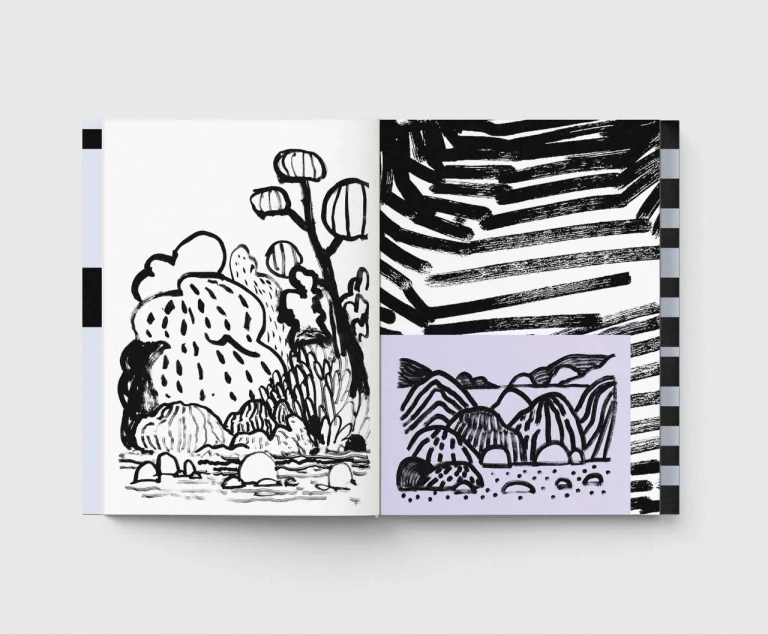
The Turin-based artist fell in love with illustration one afternoon, thanks to an Andy Warhol ink drawing. Now she works for The New York Times and the Financial Times, inspired by “ordinary” moments she once dismissed.
Ever had someone say, “Draw what you like”? It might sound like the easiest brief in the world, but I’m already stumped just thinking about it. For years, it confused Lorena Spurio, too.
“I thought it meant big passions or hobbies. I could never figure out what mine were on the spot,” she says. But funnily enough, the answer was already right there in her personal work. She noticed patterns: the sea, the moon, cats, spending time with friends, and those ‘ordinary’ or ‘imperfect’ moments we often take for granted. Basically, her drawings knew what she liked before she did.
It also explains her Instagram handle @___wabisabi. Wabi-sabi is the Japanese idea of finding beauty in imperfection. And it’s why she lists the things that make her happy on her portfolio’s About page: “Slow breakfasts, natural wines that smell horrible, fermented drinks, reading books at the beach, peanut butter and jelly sandwich, waves sound, all kind of comics, the first dip in the sea of the year, yoga, birthday cakes, staring at the moon,” it reads.
It’s made me ponder what my own list would be. A nice brew, sitting on my camper van stoop, looking out at a nice view. Being snuggled up under a blanket, watching a naff, old movie as the rain lashes down outside. Reaching a summit and standing with my hands on my hips, looking out onto the surrounding fells. In the words of The Sound of Music, these are a few of my favourite things.
The interesting thing is that Lorena now works the other way around, too. “I realise what I like by noticing that it has become a recurring element in my drawings,” she says. As in… the drawings make the connection first, and she catches up.
Born in Reggio Calabria, Lorena has since lived all over the place: Rome, Madrid, Barcelona, Milan, and now Turin. She studied literature and art history at university, and by 2018 she had completed a Master’s in Communications and Art, with only a few graphic design projects to her name. Then came a three-month course in digital illustration, “mostly just to try something new”.
Things changed quickly after that. “On the first day of my course, my teacher, Pietro Puccio, showed us a series of illustrations by well-known artists, and one of the first was Hands on the Piano, an ink drawing by Andy Warhol,” she says. “I remember being incredibly moved by it. It was love at first sight, and that was when I decided that this was what I wanted to do.”
She later completed a Mimaster Illustrazione in Milan in 2022. Even though her path to illustration wasn’t exactly straight, she credits her background with giving her a more conceptual approach to her work than a practical one. And she applies that to her illustrations for The New Yorker, The New York Times, the Financial Times, and The Atlantic. “Maybe it’s a way of thinking that comes from the method we used to study literature at university,” she says.
How is this applied to a brief? “I read it several times and start to identify some broader themes. I underline any passages that might trigger a visual idea. I read it one more time, and then I just let my mind wander wherever it wants to go.”
As part of this process, she once tried ‘mind maps’. But soon ditched them, preferring instead to “let everything happen in my head”. She thinks through figures of speech (metaphors, similes and hyperboles), and as soon as the first idea arrives, the sketching begins. Three to five sketches make the final cut and go off to the art director.
Continuing on the theme of storytelling, it’s no surprise to learn that Lorena has a soft spot for comics, too. Making them and reading them. “With a comic, you can build anticipation and suspense, just like you do in a book. Images can be really powerful and make you feel many things at once. With a comic, you can take your time; you can create a sort of emotional rollercoaster. There will always be that magic of moving from one panel to the next, or from one page to the next, to find out what happens.”
Ask her what she’s currently reading, and it’s something by Sally Rooney. An “enjoyable” read, yes, but she’s more excited about Manuele Fior’s new graphic novel that’s due out at the end of this month. With such a love of storytelling, it’s nice to see her illustrations for Italo Calvino, chosen for the Italian Excellence exhibition that toured from Melbourne to Kinshasa to New York City. “I discovered him only by chance, through that contest,” she explains. “We could choose between a couple of titles selected by the organisers, and I chose Marcovaldo. It was so much fun, and for the first time, I discovered Calvino’s magical worlds and his unique, wonderful way of writing.” It’s why she keeps reading, she admits. Reading helps her through “some very intense moments of life,” she adds.
Lorena has seen a lot of success so far. Three years running in the Society of Illustrators annual. A finalist spot at the Bologna Children’s Book Fair. First prize at Posterheroes. Has it helped? “I can’t say these awards have made a concrete difference to my career, or whether awards in general can make that kind of difference,” she says. “What I do know is that it’s always exciting and motivating to put yourself out there, get feedback, and be recognised by different international juries. Awards are important milestones. They help you build your portfolio and, in a way, they can help establish you at a higher professional level.”
Then comes a but: “There are some things that awards simply can’t guarantee, like getting commissions on a regular basis, or even getting any commissions at all. You can be an illustrator with very few awards and be constantly busy with work, or you can have many but not necessarily get more work because of them.”
The precarious nature of illustration doesn’t really care about awards or recognition. It can affect everyone, anytime.
Something to write on a Post-it note and pin to your laptop screen, perhaps?
What’s next for Lorena? She’d like to paint on a larger scale and learn the basics of a new language, with Japanese as her goal. And even “train until I can finally do a backflip,” she says. We’ll be keeping an eye out for the video.