Work for The Telegraph Magazine
Known for his retro illustrations for big-name clients, the Argentine artist explains how he stays human in the age of AI.
Ask most illustrators to name their career highlight, and you’ll get their biggest client: the global drinks brand, the broadsheet cover, the company whose logo makes other creatives sit up. But Marcos Montiel, the Argentinian illustrator behind Cinzano’s picnic-and-food-truck campaign and covers for The Guardian, The Economist and The Washington Post, doesn’t pick any of that. He picks a jigsaw puzzle.
It’s a simple response that says a lot about how Marcos thinks about his work. His passion is less about racking up an impressive client list, more about guarding his own creative habits. And for anyone building a creative career, that’s an approach worth considering.
The object beats the image
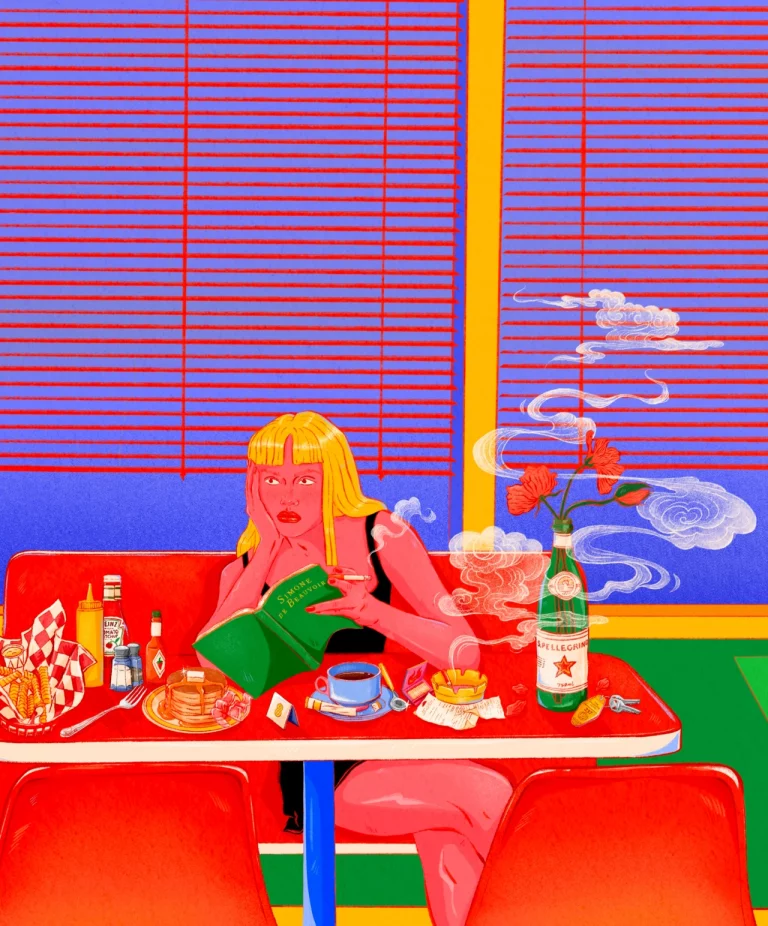
Marcos’s style is instantly recognisable. Typically, his pictures are retro, warm, and dense, with small human gestures that make a scene feel lived-in, whether that’s a hand reaching for a vermouth glass on the grass or a man crouched over a crate of vinyl.
Work for Cinzano
His editorial illustrations may get most attention, but he’s passionate about packaging and product work too. “I’m fascinated by the idea that a painting or a drawing can live alongside an object, and communicate something more than just a pretty picture,” he enthuses. “The moment someone can hold a piece of work, turn it over and bring it into their daily life, it becomes something else entirely: not an image any more, but a relationship.”
All of which neatly brings us back to that jigsaw puzzle for Monoblock. “It was a really fun project to make,” Marcos recalls. “Because it let me see my work turned into an object that people could interact with, especially children.”
In this light, it’s not surprising it comes top in his list of affections. No brief, no budget line and no client logo can compete with watching a kid’s hands assemble your drawing on a kitchen table.
Two cities, one voice
Marcos has built his career across two very different creative economies: Buenos Aires, where he’s based, and London, where he’s worked as a freelancer and is represented by Synergy. Rather than picking a side, he treats the contrast as useful friction.
Work for Martha
Collaboration with Monoblock
Local Argentine work, he explains, tends to be rooted in custom, identity, and how a place represents itself, while the international market leans more heavily into concept and editorial thinking. Working across both, he says, gives him “a perspective that’s broader and richer,” letting him fuse everyday observation with something more abstract.
It’s a good working model for anyone who splits their time between a home market and global clients, and a reminder that those two audiences don’t actually need to compete for a fixed idea of “your style”; they can sharpen each other instead.
Pencil first, screen second
For years, Marcos worked almost entirely on a digital tablet, which sped up sketching, revisions and final production. But the rise of AI-generated imagery has led him back towards analogue.
“The arrival of artificial intelligence pushed me to reconsider the importance of the author’s hand and personal gesture,” he explains. Nowadays, then, his workflow starts with pencil on paper, moves to line correction and colour on an iPad, and only reaches Illustrator and Photoshop for formatting and final files.
It’s a small but significant shift: not rejecting technology outright, but bringing the bit that a machine can’t fake to the front of the queue. For illustrators wondering how to hold on to a distinct voice in the AI era, it’s worth thinking about.
Work for New Scientist
Personal work
Marcos is also doubling down on personal work, such as his popular stickers. Their success stems in part from the way he treats unpaid personal work.
“My method has always been based on treating every personal project as though it were a commercial commission,” he explains. “I apply the same seriousness and dedication to both.”
Genuine and authentic
Asked what he’d tell someone starting out, Marcos resists the urge to hand over a shortcut. “There’s nothing more solid and lasting than a genuine, authentic expression of your own,” he maintains. “Working hard is the key to finding and developing it.”
In other words: produce constantly, share what you’re genuinely proud of, and accept that identity isn’t a brand exercise you complete in a weekend. Instead, it’s built piece by piece, just like everything else on his desk.
As Marcos puts it: “When the mundane spirit speaks, detail is a universal language.” It’s as good a mission statement as any, for a career built on noticing the small stuff… whether that ends up on a bottle label, a broadsheet front page or 100 jigsaw pieces on a child’s bedroom floor.